Why the Streets of Tehran Are Finally Burning Down the Prison
History books love the term “Dark Ages.” We are told that while Europe was busy eating mud and forgetting how to build roads, the Islamic world was entering a glittering “Golden Age” of science and philosophy.
That’s a cute story. It’s also complete and utter bullshit.
What they call a “Golden Age” was actually just a hostile takeover. It wasn’t a magical awakening of Bedouin intellect in the desert. It was the result of a military machine conquering ancient, advanced civilizations, putting a sword to their throat, and saying, “Nice library. It’s ours now.”
This wasn’t an era of discovery. It was an era of appropriation.
The Catalyst: Theft, Not Inspiration
The intellectual explosion didn’t start with a divine revelation. It began with a kidnapping.
In 751 AD, the Abbasid army clashed with the Chinese Tang dynasty at the Battle of Talas. The Arabs won, but they didn’t just take land. They took prisoners of war who knew a specific trade: papermaking.
Before this, the Middle East was stuck using expensive parchment or fragile papyrus. Suddenly, they had the technology for mass communication. The Caliphs didn’t invent the medium; they stole the tech from the Chinese and used it to photocopy the world’s knowledge.
The “Arab” Intellectuals (Who Were Definitely Not Arab Nor Muslim)
If you look at the roster of the “Islamic” Golden Age, you notice a pattern. Almost none of the heavy hitters were Arabs. They were Persians, Central Asians, and North Africans living under occupation. I present to you the “Hostage Hall of Fame”:
Al-Khwarizmi: The Tech Bro Ancestor (9th Century)
The father of Algebra. He invented Algebra (Al-Jabr). His name, Latinized, became “Algorithm.” Without him, there is no Google, no AI, no software. He also brought the Hindu decimal system (0-9) to the West (another example that “Arabs” stole the numbers, rebranded them, and called them “Arabic numerals”). Try doing math with Roman Numerals (seriously, try to divide MCMLXXXIV by VI); it sucks. He fixed that. He wasn’t from Saudi Arabia. He was from Khwarazm (modern-day Uzbekistan). He was a Persian mathematician working in Baghdad because that’s where the funding and the guy with the sword were located.
Al-Razi: The Heretic Who Saved Your Life (9th–10th Century)
If you think claiming a Persian mathematician was bad, wait until you meet Al-Razi. Known in the West as Rhazes, this guy was the medical heavyweight of the 9th Century. He was the first to distinguish smallpox from measles and to basically invent pediatrics. He didn’t just read books; he ran the hospital in Baghdad while the rest of the world was treating flu with leeches. Born in Rey (near modern-day Tehran), he was yet another Persian carrying the team. But unlike the others who kept their heads down to survive, Al-Razi chose violence. He was openly critical of the concept of “prophets,” effectively calling revealed religion a fable for the masses. In a sane world, he would be a hero of skepticism. In the “Islamic Golden Age,” the Empire just cherry-picked his medical cures, burned his philosophy, and slapped a “Muslim Hero” sticker on his forehead. He is the ultimate irony: a man who cured physical viruses while the state that claims him was spreading the ideological virus he despised.
Al-Biruni: The Anthropologist Held at Gunpoint (10th-11th Century)
If Al-Khwarizmi was the “tech bro,” Al-Biruni was the guy they kidnapped to run the data analytics department. Born in Khwarazm (modern-day Uzbekistan), Al-Biruni was another brilliant Persian mind minding his own business until the Empire came knocking. He didn’t move to the capital for the “culture”; he was taken there as a spoil of war by Sultan Mahmud of Ghazni. His Wikipedia page lists his religion as “Islam”, which is hilarious because his life’s work was basically ignoring religious dogma to understand the rest of the world. While the “Islamic” armies were busy smashing “infidel” idols in India, Al-Biruni was doing something radical: he was actually learning Sanskrit. He became the first “Indologist,” translating Hindu texts and treating their culture with objective respect instead of religious arrogance. He spent his life studying the “infidels” with an open mind, yet history stamps “MUSLIM” on his forehead just because he lived under a Caliphate that would have executed him for stepping out of line. He wasn’t a product of the system; he was a survivor of it.
Ibn Sina / Avicenna: The Philosopher and Physician (10th–11th Century)
The guy who wrote The Canon of Medicine created the textbook used in European medical schools for 600 years. Born in Bukhara (Uzbekistan), died in Hamadan (Iran). He was as Persian as it gets. He wrote poetry in Persian. Calling him an “Arab scientist” is like calling Albert Einstein a “Nazi scientist” just because he lived in Germany before fleeing.
Omar Khayyam: The Poet and Polymath (11th–12th Century)
While the lunatic Empire was obsessed with the moon, Khayyam calculated the solar year with such insane precision that his Jalali Calendar is still more accurate than the Gregorian calendar the West uses today. He was a math prodigy who solved cubic equations, but he spent his free time writing poetry (Rubaiyat) about drinking wine and mocking religious hypocrisy. A true Persian rebel.
The “Hotel California” of Theology
Why did they work for the Caliph? Because the alternative was poverty or death. The early Islamic Empire was a protection racket. If you weren’t Muslim, you paid the Jizya (a heavy poll tax). If you wanted a government grant to build an observatory or translate a Greek text, you played ball with the state religion. It was a “convert or die” economy. And once you checked in, you could never leave. Under Sharia law, apostasy (leaving the religion) is punishable by death. That’s not a “Golden Age” of free thought. That is a high-security prison with an excellent library.
The 1,400-Year-Old Hostage Situation
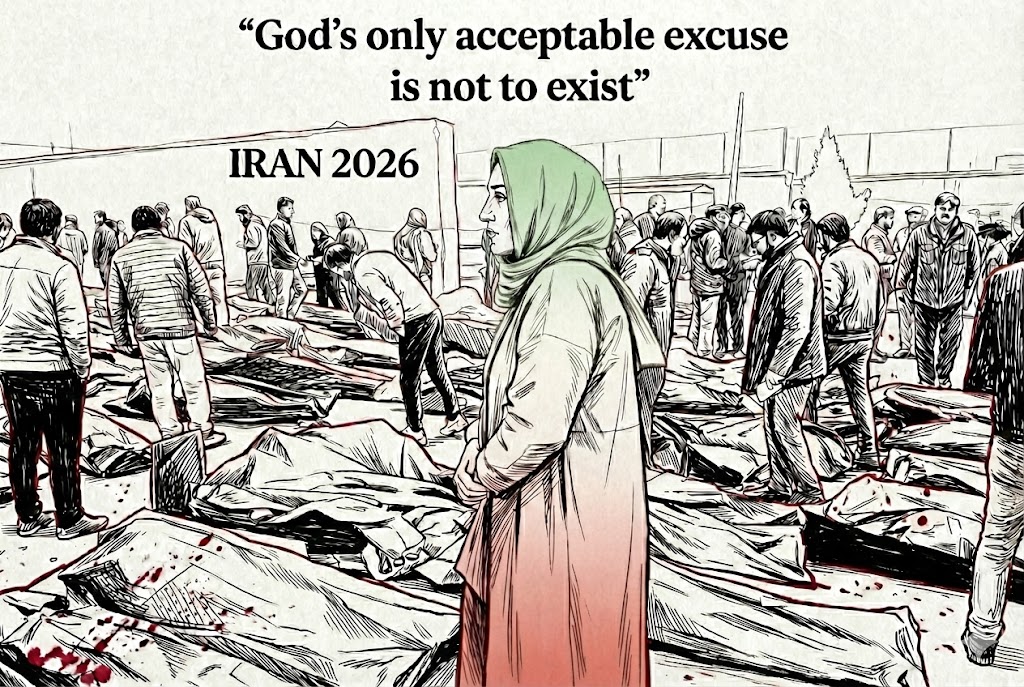
This brings us to today. Turn on the news and look at Iran. The Western media, terrified of being politically incorrect, calls the current uprising a protest against “economic corruption” or “strict dress codes.”
They are missing the point by A LOT.
Iranians are currently burning down seminaries and religious centers. They aren’t doing this because they are bored; they are doing it because they recognize those buildings for what they are: colonial outposts. For 1,400 years, the Persian identity has been held hostage by an ideology that demands total submission. The 1979 “Revolution” wasn’t a return to tradition; it was a foreign policy decision. It was a coup, lubricated by Western intelligence agencies (CIA and MI6) who decided a religious lunatic would be easier to control than a nationalist leader. We know their track record. They didn’t just “fail to predict” it; they cleared the runway for it, just like they orchestrated the coup in 1953 against Mosaddegh.
But today is different. This isn’t a political dispute. It is a civilization finally rejecting a foreign virus. The “Islamic Golden Age” scholars were the first hostages, brilliant minds forced to work under a system that hated their questions but loved their results.
The world is trained to look for tragedies that happen in a decade. We build museums for genocides that last a few years and count the victims in the millions. But we are blind to the tragedies that span a millennium. What happened to Persia wasn’t a twelve-year slaughter. It was a 1,400-year suffocation. It didn’t just kill people; it tried to kill a memory and rewrite history. The kids dying in the streets of Iran today? They are just the first generation brave enough to burn the prison down.
Credit Where It’s Due: The historical research data was gathered using Google Gemini.


 Cognitive Shifter
Leave a comment